
Free AI
Detector
for ChatGPT, Claude & Gemini text
Paste any writing into the AI checker below and see how much of it reads as machine-generated, sentence by sentence. Free, no account, and nothing you paste is stored.
- No signup
- No daily limit
- Up to 50,000 characters
- Nothing stored
What is an AI Detector?
An AI detector reads a piece of writing and estimates how likely it is to have come from a language model like ChatGPT, Claude, Gemini or Llama rather than a person. It is not checking facts or searching for copied phrases — it is measuring how the text is written.
Two things give machine writing away. Its word choice is unusually predictable, and its sentences are unusually even in length and rhythm. People write in bursts: a long digression, then a short one. Models tend to hold a steady pace all the way through. A detector scores that gap.
Teachers, editors and content teams use detectors to decide where to look closer. That is the honest limit of what they are for — a starting point for a conversation, not the end of one.
How Our AI Detector
Actually
Works
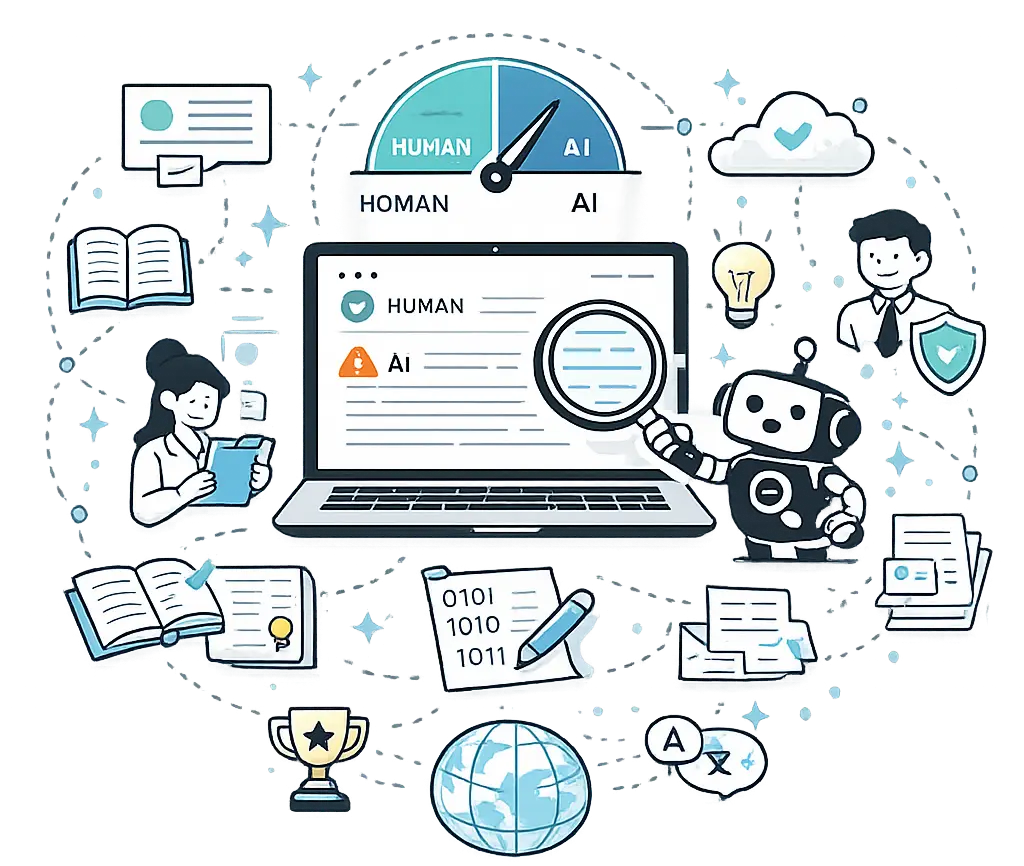
There is no magic to it. The detector measures two statistical properties of your text and compares them against what language models typically produce. Here is the whole process.
Paste your text
An essay, an article, an email — anything from 50 to 50,000 characters. Longer passages give steadier results; under about 150 words there is not enough to go on.
Two measurements
Perplexity — how predictable each next word is. Burstiness — how much sentence length varies. Low on both is the machine-writing signature.
A score, with its reasons
You get a 0–100 probability and highlights on the sentences that drove it, so you can judge whether the flag makes sense instead of taking the number on faith.
What this score is not
Most detectors lead with an accuracy figure. We would rather tell you where the number breaks down.
Not proof
It is a probability. There is no detector, here or anywhere, accurate enough to justify a grade or a firing on its own.
Not a plagiarism check
Nothing is compared against other documents. Text can be entirely original and still score as AI, and copied text can score as human.
Not Turnitin's score
Turnitin runs its own model inside its own platform. No outside tool can reproduce what its report will say.
Who actually uses this
Six situations where an AI detector score is genuinely useful — and what to do with it once you have one.
Research Papers
Journals increasingly ask authors to disclose AI assistance. Scan a manuscript before submission so you know what a reviewer’s tool is likely to flag.
School Assignments
A score is a reason to ask for draft history, not a reason to accuse. False positives hit second-language students hardest.
Articles & Blogs
Check what a freelancer filed before it goes live. A high score usually means the draft needs a real edit pass, not that it needs binning.
Business Comms
If a memo scores high it is often just flat writing. Use the sentence highlights as an editing checklist for the parts that read as filler.
Social Media
Short posts are the least reliable input there is. Under about 150 words the score is close to noise — treat it as a hint at most.
SEO & Web Copy
Google does not penalise AI content for being AI, it penalises unhelpful content. Use the score to find pages worth rewriting, not to purge a site.
Checking AI text in other languages
The signals a detector measures — how predictable each word is, how much sentence length varies — are not English-specific, so the detector will return a score for text in any language that uses a Latin script.
Accuracy is strongest in English and holds up reasonably well in Spanish, French, German, Italian and Portuguese. Be more sceptical of results outside those languages, and of any text that has been machine-translated: the translation step flattens exactly the variation the detector reads.
Most reliable. Detectors are trained and evaluated overwhelmingly on English, and it is where published accuracy figures come from.
Usable, with more false positives than English. Worth a second opinion before acting on a high score.
You will get a number, but treat it as a rough signal only.
Least reliable case of all. Translation flattens the sentence-length variation the detector reads, so human writing run through a translator frequently scores as AI.
What an AI detector measures
Two measurements, and the honest caveats that come with each.
01 Why patterns, not keywords
There is no list of banned words. Word-spotting does not work, because a model can write about anything using perfectly ordinary vocabulary. What gives it away is the shape of the writing, not its subject.
A model picks each word from a probability distribution and, left alone, tends to pick near the middle of it every time. That produces prose that is fluent, even, and slightly too smooth. People digress, over-explain, cut themselves short and change register mid-paragraph. The detector scores how much of that human unevenness is present.
02 Perplexity & burstiness
Perplexity is how surprised a language model would be by your next word. Low perplexity means the text went where a model would have gone. Burstiness is how much sentence length varies across a passage. Human writing swings; model output holds a steadier line.
Both are proxies, and both can be wrong. A careful writer editing for clarity strips out the same variation the detector is looking for, which is why polished, formal and second-language writing gets flagged more often than messy first drafts. When the signals disagree you get a Mixed result — which means inconclusive, not "slightly guilty".
Every scan shows its working
You see which sentences moved the number, so you can disagree with it.
How to read your AI detection score
The score is a probability, not a verdict. Here is what each band actually means and where the detector is least reliable.
Reads as human
Sentence length varies, word choice is less predictable. Most unedited human drafts land here.
Mixed or inconclusive
Common in AI-assisted drafts a person then edited, and in highly formal or technical human writing. Treat as inconclusive.
Reads as AI-generated
Consistent rhythm and highly predictable word choice. Check the highlighted sentences to see what drove the score.
When the score is least reliable
- Short samples. Under roughly 150 words there is not enough signal. Longer passages give steadier results.
- Second-language writing. Simpler vocabulary and more regular sentence structure read as machine-generated even when they are not.
- Formulaic formats. Legal boilerplate, lab reports, technical documentation and listicles are naturally low-variance.
- Paraphrased AI text. Running model output through a rewriter suppresses the patterns detectors look for, so AI writing can score as human.
No detector on the market, including this one, is accurate enough to justify an academic or employment penalty on its own. Pair a high score with draft history, revision timestamps and a conversation with the writer before drawing a conclusion.
Frequently Asked Questions
Got questions about how to check AI written content? We've got answers.
What to do with a high score
A number came back high and now you have a decision to make. Before you act on it, know what the tool did and did not tell you: it compared the statistical texture of the writing against what language models typically produce. It did not read for meaning, check any sources, or compare the text against anything else ever written.
So start with the highlights rather than the headline number. If the flagged sentences are the generic connective tissue — the summary paragraph, the transitions, the conclusion that restates the introduction — that is a writing problem worth fixing whoever produced it. If the flagged sentences are the specific, argued, detail-heavy ones, the detector is probably wrong.
If you are on the receiving end of an accusation, the score is not the thing to argue with. Version history, saved drafts, notes and search history are, because they show the work happening over time — and no detector can produce evidence of that kind. Our guide to false positives covers what to gather and how to present it.
How detection actually works
Perplexity is how predictable the next word is. Burstiness is how much sentence length varies. Models hold near the average on both; people do not. That gap is the entire basis of every detector on the market, including this one.
How detection worksAI content and Google rankings
Google has said plainly that it does not penalise content for being AI-generated — it penalises content that is unhelpful. The overlap is large, but they are not the same thing, and the difference decides what you should actually do about it.
What Google actually saysIf you are a student
You cannot use this to predict your Turnitin result. Turnitin runs its own model inside its own platform and no external tool reproduces it. Anyone telling you otherwise is selling something.
What a scan here can tell you is whether your writing has the flat, even texture that trips detectors — useful information if English is your second language or if you have edited a draft until all the personality is gone. Both are common reasons honest work gets flagged.
We would rather you did not treat the score as a target to beat. Rewriting until a number goes down teaches you to write for a classifier, and the classifiers change. Keeping your drafts, notes and version history is the thing that actually protects you if the accusation ever comes.
Other free tools here
Small utilities for the editing pass that usually follows a scan.
Run a scan
Paste your text, read the highlights, decide for yourself. No account, no limit, nothing kept.
Start Detecting Now